
Just last week, I received a frantic call from a client. His German business partner had flown into Shanghai for a specific stem cell therapy, assuming the 15-day visa-free entry would be plenty of time.
The problem? The doctors adjusted the treatment plan, requiring him to stay for 40 days. With his visa-free period expiring in 48 hours and the hospital paperwork incomplete, he was facing a potential overstay penalty and a forced flight home in the middle of his treatment.
We fixed it, but it was a close call.
As China’s medical sector gains global recognition for high efficiency and cost-effectiveness (especially in dentistry, IVF, TCM, and complex surgeries), more foreigners are choosing “Reverse Medical Tourism.”
However, getting medical care is not the same as tourism. Healing takes time, and bodies don’t always follow schedules.
Here is the straightforward guide on how to handle your China entry for medical purposes, and specifically, how to transition from a “Visa-Free” entry to an “S2 Visa” so you can focus on getting better, not on bureaucracy.
1. Know Your Entry Options: Don’t Guess
Generally, there are three ways to legally enter China for medical help. Choosing the wrong one is the most common mistake.
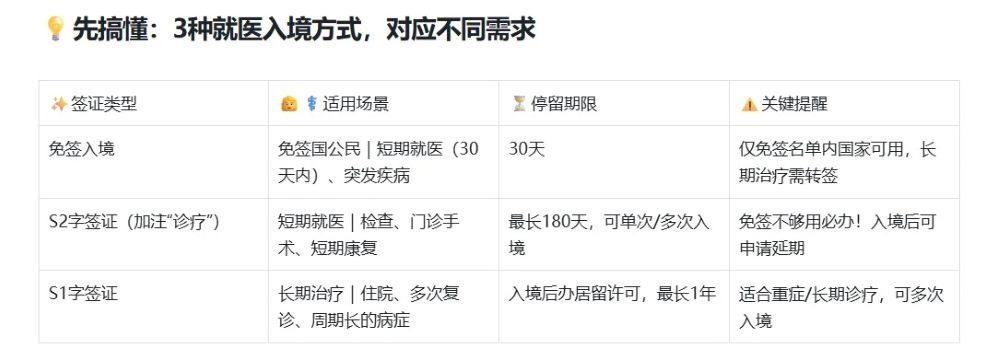
- Visa-Free Entry (15/30/144-hours):
- Best for: Quick check-ups, second opinions, or simple dental work.
- The Risk: Strict time limits. You usually cannot extend this easily. If complications arise, you must leave.
- L Visa (Tourist):
- Best for: Short-term stays where you combine travel with minor medical procedures.
- S1/S2 Visa (Private Affairs – The Gold Standard):
- Best for: Hospitalization, long-term rehabilitation, or uncertain treatment timelines.
- Why you want it: The S2 Visa covers short-term private affairs (including medical treatment) usually up to 180 days. The S1 Visa is for stays longer than 180 days and requires a residence permit.
Scenario: “I’m already in China visa-free, but I need to stay longer.”
This is where many patients get stuck. If you entered under a visa-free policy but your doctor says you need to stay, you must act fast. Do not wait until your last day.
You need to apply for a conversion to an S2 Visa at the local Entry-Exit Administration Bureau at least 7 days before your current stay expires.
✅ The Decision Matrix
- Can you finish treatment within 30 days? Great. Stay on your current status.
- Will it take months? You must apply for an S2 Visa immediately.
The “S2 Visa” Document Checklist
Chinese immigration officers are strict but fair. They need to see a clear logic: You are sick, you can pay for it, and you have a place to stay.
You will need:
- Valid Passport & Photos: Ensure your passport has at least 6 months of validity left.
- Medical Diagnosis Certificate:
- Must be from a recognized hospital in China (issued within the last 6 months).
- Hospital Invitation Letter:
- Crucial: This is not just an appointment slip. It must be an official letter stating: Reason for treatment, estimated duration, and proof that costs are covered.
- Tip: Navigating Chinese hospital administration to get this specific letter can be a nightmare. Our Medical Escort Service specializes in this—we speak the doctor’s language and the immigration officer’s language.
- Proof of Funds:
- Bank statements or insurance guarantees proving you can cover medical bills and living expenses.
- Accommodation Registration:
- By law, you must register with the police within 24 hours of arrival. If you are in the hospital, they do it. If you are in an Airbnb or apartment, you must go to the police station yourself.
Why You Shouldn’t Do This Alone
Navigating a foreign medical system is stressful enough without adding visa anxiety.
- The Language Barrier: Medical terminology is hard enough in English. In Chinese, it’s impossible for most foreigners.
- The Payment Gap: Many Chinese hospitals do not accept international credit cards easily.
- Compliance: One mistake on your application form can lead to a rejection, forcing you to fly home while ill.
At Zerrand, we bridge this gap.
- Visa Support: Whether you are applying from your home country or need to extend your stay while in China, our China Visa Assistance team handles the bureaucracy.
- On-Ground Support: Our Medical Escort Services provide a dedicated bilingual companion to handle hospital appointments, translation, and paperwork, so you can rest.
⚠️ Critical Reminders
- Authenticity Matters: Never submit fake documents. The hospital and immigration systems are linked. A fake diagnosis will get you banned from China.
- S1 vs. S2: Remember, if you get an S1 Visa (for long-term treatment >180 days), you strictly have 30 days after entry to convert it into a Residence Permit. Missing this window makes your stay illegal.
China’s medical care is fantastic, fast, and affordable. Don’t let a piece of paper stand between you and your health.
If you are planning a medical trip or need urgent help extending your visa, contact Zerrand today. We are here to help.

You need to log in to post a comment.
Log In